Greider Lakes

I got to go hiking with friends for the first time in a couple of months again this Sunday – this time to a series of lakes an hour and a half drive north east of Seattle. The drive there was miserable – I gave myself a headache from staring at my phone, and forgetting to eat breakfast left me a nausea that lasted all 90 minutes there. It was a relief to get out of the car, but I dreaded the return trip – I was not especially accustomed to long car rides.

The trail itself was curiously divided into three distinct parts – two flat and one not-so-flat. Almost 1500 ft of elevation within a mile and a half – huffing and puffing indeed, just as the WTA website promised. It was this that really made the experience. I was out of shape: hell, I was already sweating during the few miles of flat trail, so it was a whole other beast to start the ascent. I pushed myself to that point you get to when you haven’t run in a while – that migraine that sits in your temples and behind your eyes that is somehow purifying, cleansing the mental fog of inactivity. I admit I had to stop a couple of times to break for water, but by the 33rd (36th? 40th?) switchback I was done with the hard part, according to the friendly couple on their way back down. I must have been quite the sight – absolutely drenched in sweat, my oft-questioned choice of yellow-green workout shirt sticking to every unflattering angle; a black school backpack covered in dirt from the breaks; a giant liter-large plastic bottle of Kirkland Signature water excavated from my parent’s basement half a year ago to achieve its final destiny of replacing what was lost in only an hour of the hike.

I was happy though. In that one moment, after most of an hour thinking of nothing but the next switchback turn after turn, the satisfaction of reaching the top was incredible. It was the happiest I had been in weeks, I think. Then just another few minutes to the first lake viewpoint, and I sat down on a rock jutting into the side and let every muscle in my body relax, and I just was. No self-deprecation or regret or irritation. I just was.
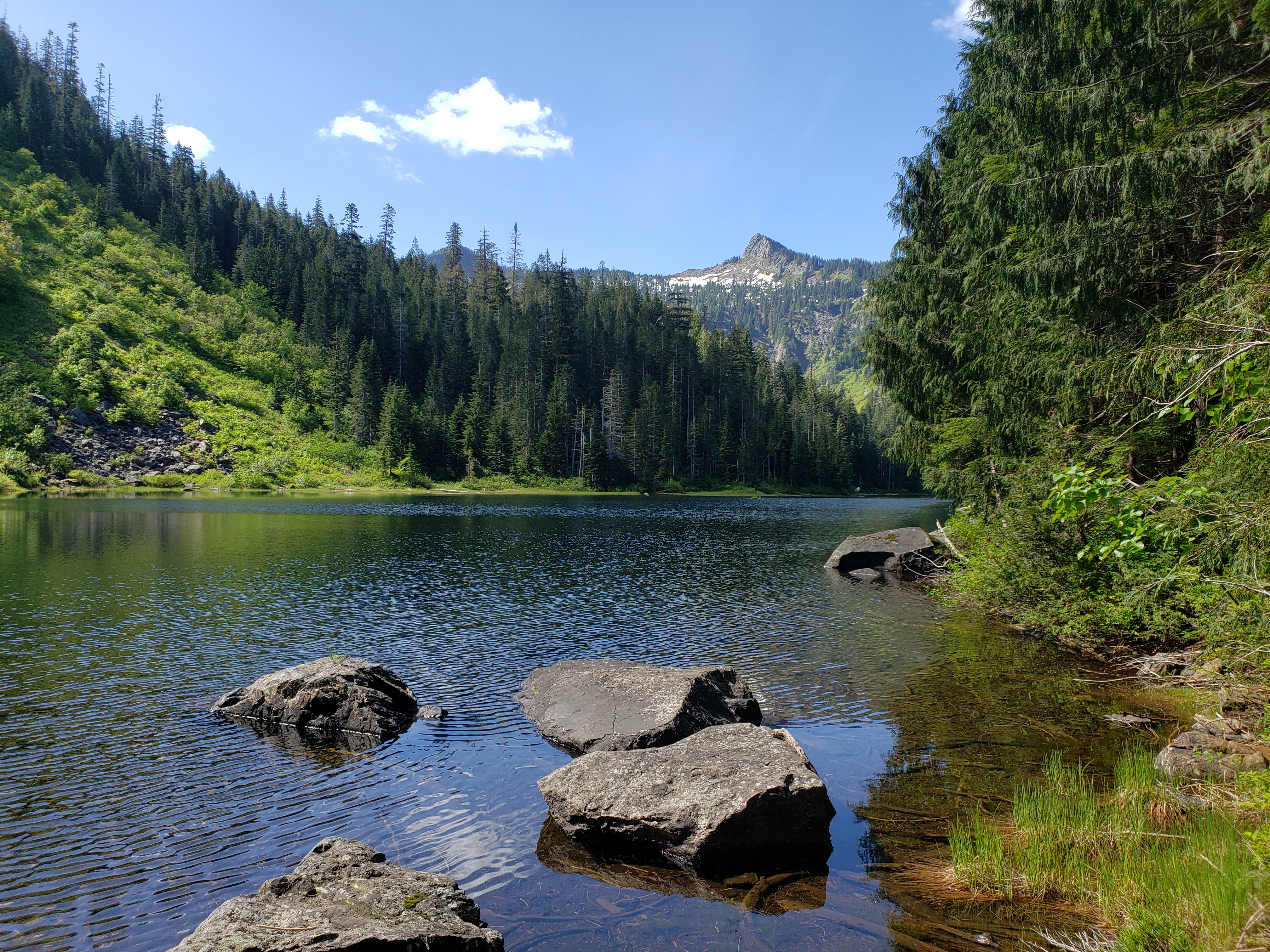
It was good. It was so, so good.

Eventually my friend caught up to me and we ventured off to find the trailblazer of the group that shot up the mountain in record time. We rendezvoused at the final lake view and ate.
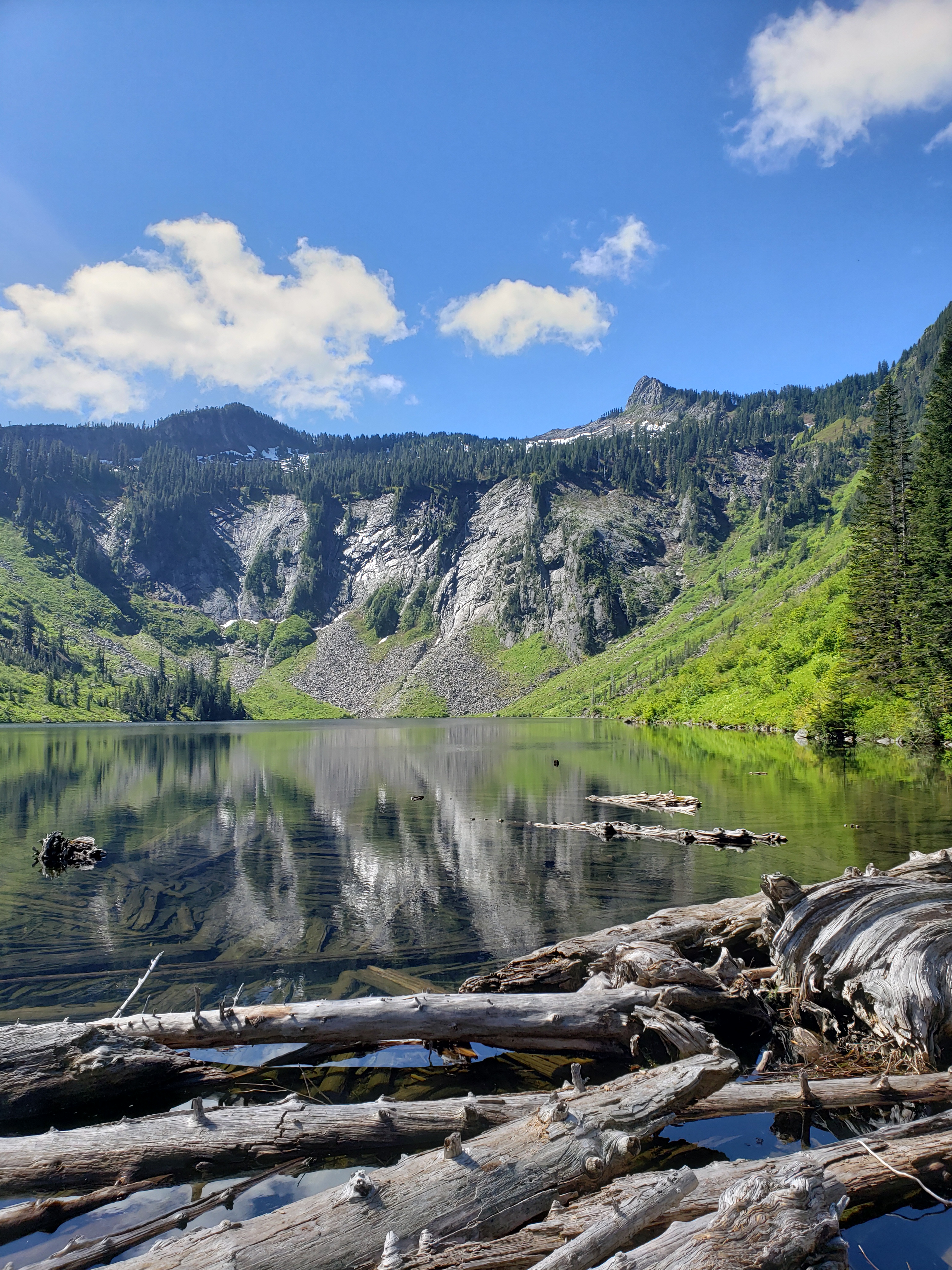
Perfect time for Cliff bars and banter. A butterfly even landed on my friend’s head. A dog came over from a few feet away explicitly to shake itself dry on my shoes. An older hiker asked if there was any real trail left – there wasn’t, although it was supposedly possible to scramble up the three peaks, the third more to the left behind us.

I don’t know if I can describe why I had so much fun. Maybe it was because I had spent the past few weeks inside, and the change of pace made all the difference. I certainly needed the exercise, and the associated endorphin rush that follows a good workout. But also, the view. The smell. The sounds of birds chirping and flies buzzing and friends talking. The silence of my own mind.

To be overly analytical, there is a theory that plant biodiversity has some sort of impact on mental health. There must be something to complexity, and, conversely, simplicity. Much of art is supposed to be representations of patterns found in nature, after all, and then of course this is subverted by intentional simplicity. Same way realism gets subverted into the abstract. But the best way I can put it is as texture. In a landscape it can, to a degree, be pleasing to have stuff that draws the eye, as long as crowding is avoided. The layers too – contrast between the lake and the trees and the distant peaks.

Something so good can only last so long – the high was pretty much over by the time I made it back to my apartment. The drive back wasn’t so bad though. I got a chance to just stare out the window and day dream, like I used to on day trips with my parents as a kid. It was good while it lasted, and I want to do it again. I think that perhaps the secret it is finding things that make you happy like this and doing them consistently. Maybe then perspective on life will change a little bit for the better. But get back to me once I’ve made it.

Family – Section 1

“More lard.” Abuelita Castilla tutted from her chair across the room. The old woman was propped up with a plank of wood for a spine, known for putting her own grandchildren’s posture to shame. She took a sip of her tea – peppermint – and continued where she had left off in her ramblings on Spanish history.

“Sancho II was a great man, Carlos,” she asserted, sagely. Every “Carlos” was said with great emotion, almost a growl, an implicit threat to listen. “Back when España was still divided, he brought Castile, León, and Galicia together. His father was stupid for dividing them among his children,” this said with a flick of her wrist, “as if he wanted them to fight against eachother.

“Sancho would have brought together more if he wasn’t stabbed in the back, too – always look behind you, Carlos, you never know when someone will take advantage of your kindness. You’ve always been too kind, too trusting. If you ever have anything worth taking someone will try to take it from you. Lord help you then, and now if you don’t add more lard, Carlos, we’re making comida Mexicana,”

Abuelita Castilla pushed her chair back and waddled over to the stove, grabbing the spoon out of my hand and shoveling another two spoonfuls of pork fat into the frying pan herself. I pursed my lips in disagreement – by some miracle my abuela was only moderately overweight, but not for a lack of trying. My mother insisted I spend some time with her after my uncle almost killed her, but she so far did not betray any unusual emotions – impossible to read, as always.

“It took another 400 years to bring all those regions together. What España could have been…” Abuelita sighed and sat down again at the table. I never understood this passion of hers for Spanish history, and especially for these old kings of which she claims ancestry. It made her proud, this Spanish blood, but she would forget the power Spain had over the old and new world, as she did now. Abuelita did not speak again until after we had eaten – fried pork, refried beans, tortillas, homemade salsa – a good, traditional dish, good enough to make her talk, and this time she spoke about her son.

“Miguel never had the Castilla blood. Diluted out, more of his father than me. My husband, he was a fine man, Carlos, but not a Castilla. No, more Indian, something less – he lacked our fire, our ambition,” this time a closed fist over her heart.

“Miguel too, always wanting to waste time on women and painting. I told him he wouldn’t make any money that way, but he wouldn’t listen, and look who was right in the end! Thirty-four, no money, living with some good for nothing cholos because he’s too proud to admit he was wrong. When he knocked on my door that night, I thought he was finally ready to give up. He came in yelling about his passion, though. Hah! If he had a real job he wouldn’t be yelling all the time – I tell him this, but what does he do? He should have been more like Tia Grace, she’s a woman but has the spirit of a man, of my father. She’s a true successor to the family – she will be the next Abuelita.” The current Abuelita nodded pensively, solidifying the thought. Tia Grace was adopted at seven by my grandmother from an orphanage in San Diego, and ever since has been her favorite child. She was never afraid of choosing favorites – maybe that was why Miguel hated her.

“So he comes into this house, angry, as I said, and yelling, breaking stuff – those were good dishes, gifts from your papa – and then he pulls out the gun.” Suddenly she grabbed me from across the table, surprisingly me with her strength, and dug her nails into my forearm.

“I looked him right in the eyes, and I dared him! And that sorry bastardo couldn’t even finish the job.” She collapsed back in her chair, cursing, and continued, “He missed. Panicked and ran out the front door. Pathetic…”

She trailed off weakly, gazing out the window to her right overlooking the backyard. I just sat and stared at her, not knowing what to say.

“What will I do, Carlos? Mi hijo!” She lamented, eyes brimming with tears. “He needs his family!”

Happiness

“Brower said, without emphasis, ‘That is what is known in my trade as a scenic climax.'” – John McPhee, Encounters with the Archdruid

Assuming the paradox that individuality is the cornerstone of humanity in spite of the many great generalities that can be made of the species, happiness is in and of itself dependent on the person. For some, it may be sitting by an open window in a heated house, listening to the rain patter outside and relishing in their relative dryness. For others, the company of friends and relatives on a warm day in a park, drinking beer and exchanging work stories for the greater part of an afternoon. The best of us I think can feel a particular satisfaction in teaching a concept successfully to a willing audience. Personally, happiness to me is a time of enjoyment that lasts longer than the ephemeral moments in life when I forget to doubt myself – the singularity in which I reflect on my moment in time and place holistically and have no doubts of my deserving to be there, and odd mixture of habitual self-doubt and confidence that is valuable because of its rarity. In reality happiness is all and none of these, disturbingly subjective and yet, perhaps, more betraying of human trends than at first appearance.

For David Brower, happiness was surely many things, as it is to all of us – but one notable expression of it was recorded by John McPhee as they hiked through the Cascades during the writing of the former’s biography Encounters with the Archdruid. Upon reaching an incredible view of Glacier Peak, there is a palpable moment when the view takes the breath away from the hikers, and all that can be said are words of awe. This is what Brower refers to as a ‘scenic climax’. There is something here that betrays human nature, in my opinion, in which there is beauty sought in things that make us stop thinking and simply admire, even if just for a moment. Personally, I can say that sometimes the best way to help my own attitude is to simply put yourself in a physically strenuous position, especially during a hike, and simply focus on nothing else but putting one foot in front of the other. When the hike is finished, temporarily, at the summit, and exertion is coupled with the impact of a view, I get out of my head a little bit. Exposing oneself to these moments is critical to putting things in perspective.

I think it’s a common thing for someone to ask themselves if they’re happy – it’s a critical question to ask nowadays especially, where media at large – social, advertising, etc. – suggests that everyone should be happy always. This is often in contrast with people being happy no ways, if you will, and it further cements a constant preoccupation of how the individual decides to ‘live their life to the fullest’. This is by no means a modern problem – surely it is a question that has plagued man and womankind throughout our existence, but it is no doubt exacerbated by the luxury of contemporary life. We are all too aware of the beautiful facades people put on for show, and it makes us feel left out. It’s easy to forget that people are all too good at adapting to better or worse situations, and that happiness therefore is a game we generally have to play with ourselves instead of an object that can be kept permanently. That is not to say that it is purely a state of mind and people in bad situations should just change their perspective – more so that, when possible, it helps to express what gratitude one can.

This blog, I hope, will serve two purposes: a selfish one, and, luck have it, a helpful one too. Primarily this will be an expression of my own concerns, in which I deal with the various ruminations based off my personal life, of which there will be varying relevance to the general reader. The second though, I hope, will be for this to act as a medium through which the individual can understand themselves, as if through a case study. As I mentioned, happiness is at once unique and general – it is impossible to understand it fully within any given person, but there are patterns at large. I think fiction in particular is an especially relevant tool for examining this, so perhaps this blog will become a collection of short stories examining the subject too. Whatever this blog is, though, let us use it to reflect on ourselves, and explore the implications of emotional impact behind Brower’s ‘scenic climax’. I want to believe that all it takes to start saving ourselves is a little bit of self reflection.